From Ultra-Thin Laminates to Minimum-Mass Structures
Tailored Antisymmetric Composite (TAC) laminates unlock an unparalleled feasible and manufacturable design space spanning hard, soft, and neutral laminate architectures with unprecedented simplicity in structural response.
A unique family of laminates.
TAC laminates can reach where any other laminate can.
Fiber orientation determines how a laminate resists load in different directions. TACLaminates stacking sequences are engineered ply-by-ply — angle and position — to route load efficiently through the structure instead of over-building with excess material.
TAC laminates can cover most of the feasible space (hard, soft, and neutral laminates) with just 6, 7, or 8 plies, becoming the only structural option for ultra-thin applications.
Coupling is minimal: A16, A26, D16, and D26 are zero, and B16, B26 are negligible — comparable to symmetric laminates. Quads, by contrast, always have D16 and D26 non-zero, and therefore bending-torsion coupling.
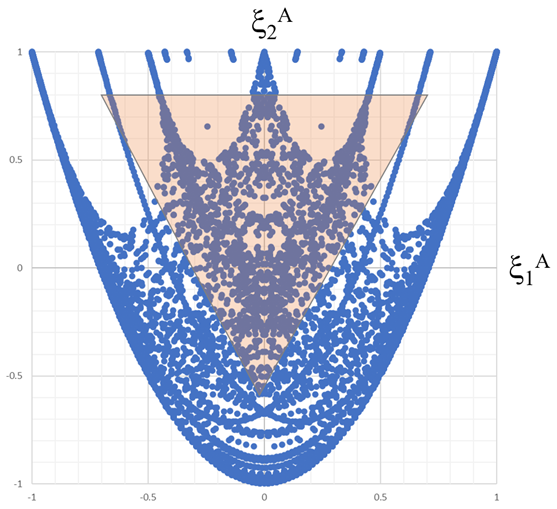
Comparison of the Feasible Design Spaces of 6- to 8-Ply TAC Laminates (Blue) and Quad Laminates
Test Data #1
Experimental warping comparison between TAC and Quad laminates after curing.
An experimental study was conducted to evaluate the warping behavior of ultra-thin composite plates — fabricated using TAC and Quad laminates — during cooling from 180°C to 22°C after curing. Four 0.5 × 0.5 m plates, two with TAC laminates and two with Quad laminates, each consisting of 8 plies, were manufactured at FIDAMC (Madrid, Spain) using a Torreslayup 11-axes Gantry CNC tape layer machine.
The test campaign pushes warpage toward its theoretical limit by using the thinnest balanced-symmetric Quad laminate allowable. Because warping grows as laminate thickness decreases, this minimum thickness applies equally to both Quad and TAC architectures. For Quad lay-ups, that lower bound is eight plies (≈1 mm), which also aligns with the flatness limits set by ASTM. The TAC panel is therefore benchmarked against an eight-ply Quad of identical thickness.
A symmetric Quad laminate with only eight plies is inherently locked into the quasi-isotropic laminate. With four orientations to satisfy symmetry/balance requirements, each orientation can appear only once in the top half and once in the bottom half, fixing the proportion of ply angles and producing in-plane quasi-isotropy. Warping was quantified by placing each cured plate on a precision-ground marble surface plate and measuring the maximum gap with a dial micrometer. For the reference TAC laminate stacking sequence [+21/−31/−12/+54/−54/+12/+31/−21], the measured distortions are listed in the table below. Two identically sized plates with a conventional symmetric Quad lay-up [+45/0/−45/90]s were fabricated and assessed in the same manner; their warping results are likewise reported in the table below.
While perfectly symmetric Quad laminates can, in theory, achieve zero warpage, this state exists only under mathematically ideal ply orientations. Sensitivity analyses reveal that even infinitesimal deviations reintroduce coupling effects and measurable out-of-plane distortion, making the “zero-warp” condition a fragile singularity.
By contrast, TAC designs are optimized over a broad, low-gradient plateau in the lamination-parameter space, rendering them inherently tolerant to fiber-angle deviations and other process imperfections. Consequently, real-world manufacturing tolerances drive both TAC and Quad laminates toward comparable warpage levels — as confirmed in the table below — but the TAC architecture achieves this with significantly greater resilience to variability.
TAC vs Quad warping measurements after curing (mm).
| Laminate | Warping measurements | Mean | Standard deviation | |
|---|---|---|---|---|
| [+21°/−31°/−12°/+54°/−54°/+12°/+31°/−21°] | 6.3 · 10−2 | 6.7 · 10−2 | 6.5 · 10−2 | 3.0 · 10−3 |
| [+45°/0°/−45°/90°]s | 5.8 · 10−2 | 7.4 · 10−2 | 6.6 · 10−2 | 1.1 · 10−2 |
One architecture, five sectors.
The same engineered-stack approach re-tunes to different load cases, environments, and certification demands.
Aero & Astro
Airframe and structural panels where mass reduction translates directly into payload and range.
Defense
Structures engineered for load resistance and durability in demanding operational environments.
Marine
Hull and structural components where corrosion resistance and weight savings both matter.
Automotive
Body and chassis components engineered for stiffness-to-weight in performance and efficiency-driven design.
General Industry
Structural and equipment components wherever excess mass is a cost, not just an inconvenience.
A new laminate family, built architecture-first.
TACLaminates approaches composite design starting from the stacking sequence, not just the base material. The result is a family of laminate architectures built to be re-tuned per application — the same design discipline applied across widely different load cases and industries.
- Design approachPly-by-ply architecture, load-path driven
- Primary differentiatorStrength-to-weight optimization
- Sectors servedAero & Astro · Defense · Marine · Auto · Industry
- StatusNew product family
Technical publications.
Papers, technical notes, and references on Tailored Antisymmetric Composite laminate design.
-
Miravete A., “Metalite, a new class of composite laminates with unique properties”, Mechanics of Advanced Materials and Structures, 2025, Vol. 32, No. 10, 2343–2354.
View publication → -
Miravete A., Cuartero J., Guzman de Villoria R., Mejia-Ariza J.M., “Tailored Antisymmetric Composite Laminates: Achieving Ultra-thin design, Lightweight Performance, and Mitigated Coupling Effects”, Composite Structures, 2026, Vol. 376.
View publication → -
Miravete A., Mejia-Ariza J.M., Cuartero J., “Solving the Paradox: Tailored Antisymmetric Laminates Are Less Coupled Than Symmetric Quadriaxial”, AIAA Journal, 2026, Vol. 64, No. 7, pp. 4277–4282.
View publication → -
Miravete, A., Mejia-Ariza, J. M., & Cuartero, J., “Towards Full Orthotropy in Laminated Composites: The Tailored Antisymmetric Concept”, Journal of Composites Science, 2026, 10(7), 363.
View publication → -
Miravete, A., Mejia-Ariza, J. M., & Cuartero, J., “Rethinking Laminate Symmetry: Robust Uncoupling and Homogenization via Universal Antisymmetric Architectures”, Composite Structures, 2026, Vol. xxx.
Forthcoming